We enjoyed a fabulous science workshop today led by an educator from the Discovery Museum (Acton, MA) and sponsored by our PTO. The children were so engaged as they learned about magnetic fields, poles, and forces that repel and attract. Check your child's backpack for a handmade Magnetic View Box as well as a short note from the museum. Many thanks to our PTO for bringing this meaningful learning experience to SES!
Thursday, May 29, 2014
Saturday, May 17, 2014
New England Animals
Your second grader has been diligently reading, researching, note-taking and writing this week! Each student has chosen to study a New England animal who lives in a freshwater or forest habitat. Their research subjects range from the red-tailed hawk and the loon to the fisher cat and the garter snake. After locating a research source and completing a note-taking template, each child is now composing a complete paragraph on his or her animal. The paragraph must include the following elements: a topic sentence, 3 evidence sentences, and a closing sentence. The children have drafted their paragraphs using 2 large index cards for the topic and closing sentences along with 3 small index cards for the evidence sentences. These cards are then edited and organized into the final paragraph. Next week, we'll add labeled diagrams of each animal and itshabitat to the project. Stay tuned!
Thursday, May 15, 2014
Measurement
We've begun a new mathematics unit on Measurement this week. We will be focusing on estimating, measuring and comparing the length of objects using standard units (inches, centimeters). Springtime household projects like gardening and painting are great opportunities for your second grader to practice his or her measuring skills
Tuesday, May 6, 2014
Flashback to April
Here is a collection of photos from Day #2 of our Writing Celebration -- another great gathering of superb second grade Informational Writing!
Monday, May 5, 2014
Powerful Poetry
Our month of studying poetry came to a close on Friday with a series of powerful poetry presentations. Each second grader chose two poems to present to the whole class. Our goal was to read each poem fluently and with expression. In addition, each student taught about the meaning and structure of his or her poem using a chart, an illustration or a dramatic retelling. Be sure to ask your child about the following poetry terms: rhyme, repetition, alliteration, stanza and line breaks.
Thursday, April 17, 2014
Celebrating our Non-Fiction Writers!
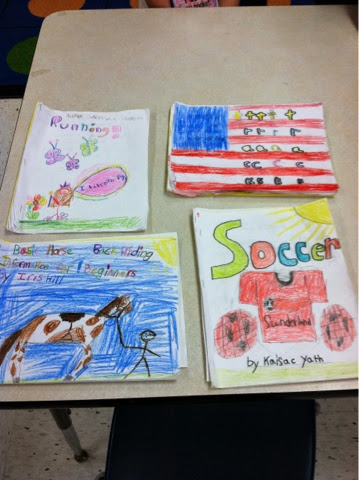
We had a fabulous Writing Celebration this morning! Thank you to all the families and friends who join us to celebrate the hard work of our second graders. There were texts on a wide range of topics from Soccer and Basketball to Cooking, Running and Skateboarding. We had a chance to see incredible Informational Texts that featured:
- Well-organized Tables of Contents
- Inspiring introductions
- Expert words
- Labeled diagrams
- A peak into the "hidden world" of many topics
- Well-organized glossaries
- Powerful conclusions
Here are some photos of our very accomplished writers:
| Wyatt is reading his book, Soccer, to Kaisac and Theo. |
| Theo is reading his book, Fishing. |
| Cole and Chris are sharing their books about Soccer. |
| Cole and Hunter |
| Theo, Wyatt and Kaisac |
| River is reading his book, Skateboarding, to Ms. Girardi. |
| Julia is reading her book, Julia's Cookbook, to her mom. |
| Samara is reading her book, About Dancing, to her mom and her grandpa. |
Sunday, March 23, 2014
I CAN . . . critique the reasoning of others.
One of the Standards of Mathematical Practice that we are focusing on in Second Grade is:
- I can critique the reasoning of others.
For second graders, this means that students can explain their own mathematical thinking and can ask questions about a classmate's mathematical thinking. For example, if Aleks tells Chris that he used regrouping to determine that 34+5=39, then Chris might ask, "Can you show me how you used regrouping?" Aleks would then expalin his work to Chris and hopefully discover that while he did find the correct sum, he did not actually use regrouping to reach his answer.
On Friday, we practiced this strategy of "critiquing the reasoning of others" by working in small groups on a single story problem.
Each student independently solve the problem, then shared his or her work with groupmates. After discussing their work, the group chose one or two of the best examples for the 3 components of the story problem:
Subscribe to:
Posts (Atom)